
An exporter wants to be paid at shipment. A buyer wants seven years to pay. Giving both of them exactly what they want, in one structure, is the entire business.
Two parties sit on opposite ends of a cross-border equipment sale and they want completely different things. The American manufacturer wants to be paid on shipment and get the receivable off the books. The buyer in Peru or Turkey wants seven years to pay, because that is how long the machine will run.
Give each of them what they are actually asking for, within one structure, and a theoretical transaction turns into a purchase order. That is what a Trade Finance Company like ours is for, and it is the most useful thing I can tell anybody about Export Finance.
Two Products, Two Parties, One Transaction
To the American manufacturer we sell comfort
Payment at shipment, in dollars, with the credit risk sitting somewhere other than their balance sheet, and without them becoming a lender to their own customer in a market they will never visit.
To the American manufacturer we sell comfort
More precisely, term. Not a lower rate and not a larger facility. Term that matches the working life of the asset they are financing.
Those are genuinely different products sold to parties who often never speak to each other. Put them together and the probability of the transaction rises sharply for both sides at once. That probability is the product. Everything else is instrument.
What Every Party Brings, and What They Get
The clearest way to see the business is to lay out everybody in the transaction, what they need, and what answers it.
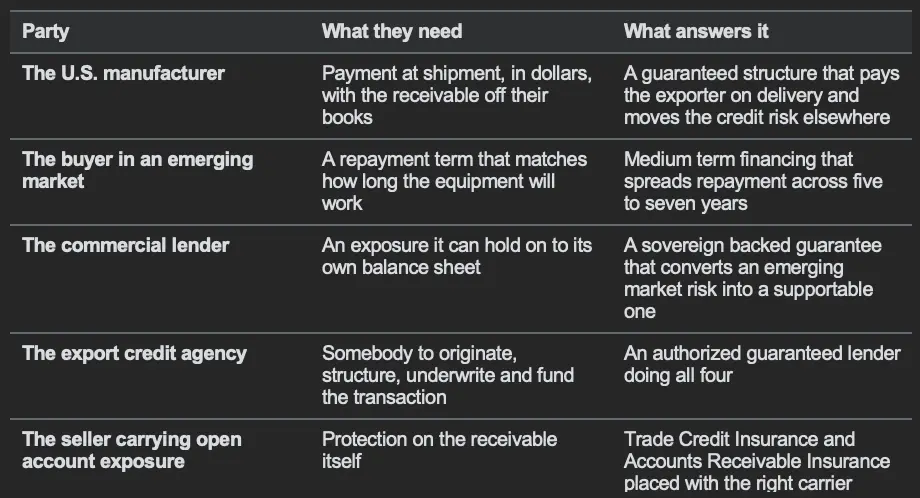
Every party in that table gets exactly what they need, and none of them can get it alone. Assembling all of it into a single set of documents that each one will sign is the job, and doing it repeatedly across Emerging Markets is the expertise.
The Term Is What Makes It Possible
A buyer wants processing equipment that will work for a decade. In their own market, credit for a purchase of that kind typically comes with a repayment period of around two years. Under EXIM’s medium term structure, repayment runs across five to seven.
Same equipment, same price, same buyer, same specification. Stretching the repayment period out by a factor of three brings the monthly obligation down by roughly the same proportion.
At two years the purchase does not fit the buyer’s cash flow, and the conversation ends. Across five to seven years it fits, and they sign. That one change in structure is the difference between an order and an enquiry, and it is available far more often than most Capital Goods Exporters realize. When a U.S. manufacturer loses one of these, the winner is usually whoever arrived with financing already attached.
Where the Value of Assembly Sits
A reasonable question is why an exporter needs anybody in the middle when EXIM provides the guarantee. The guarantee is the straightforward part. Knowing which program fits, in what order, and how to present it, is where transactions are won.
Content rules are precise and they get tested. The Country Limitation Schedule moves, and knowing which markets are open this month is a daily discipline rather than an annual check. Engineering and environmental review will ask questions, and the transactions that move quickly are the ones that answered them in the application. Repayment profiles work best when they are built around what the buyer’s cash flow actually does.
Nearly 90 percent of EXIM transactions support Small Business Exporters. Very few of those companies run a structured trade finance desk, and the good news is that none of them need to.
Why the Model Is Working Right Now
On 31 July EXIM announced it had returned to profitability for the first time in nearly a decade, having booked more transactions in twelve months than in any year of its 92 year history. Chairman John Jovanovic has been consistent about the mechanism: the Bank structures transactions that crowd private lenders in rather than substituting for them.
That is worth reading closely if you sell capital equipment abroad. Public guarantee capacity is making private capital usable in markets it would otherwise pass on, and guaranteed lenders are the route by which that reaches a buyer. A stronger EXIM and a growing private Export Finance market are the same story told from two ends.
Why this is interesting
It is a good problem. The assumption is that the constraint on Global Exports is competitiveness, meaning price, quality and delivery. Far more often the constraint is whether the party on the other end can pay in a shape that works for them, and that is solvable with structure rather than subsidy. Solve it and a plant in Ohio keeps running while a business in Lima gets equipment it could not otherwise justify. I find the second half of that at least as interesting as the first.
In Summary
We make American equipment affordable to the buyers who want it, and we make sure the Americans selling it get paid on shipment. Risk mitigation is the business, and lending and insurance are the tools.
If you are about to quote a buyer overseas, the most valuable conversation is the one about how they will pay for it, and it is worth having before the quote goes out.